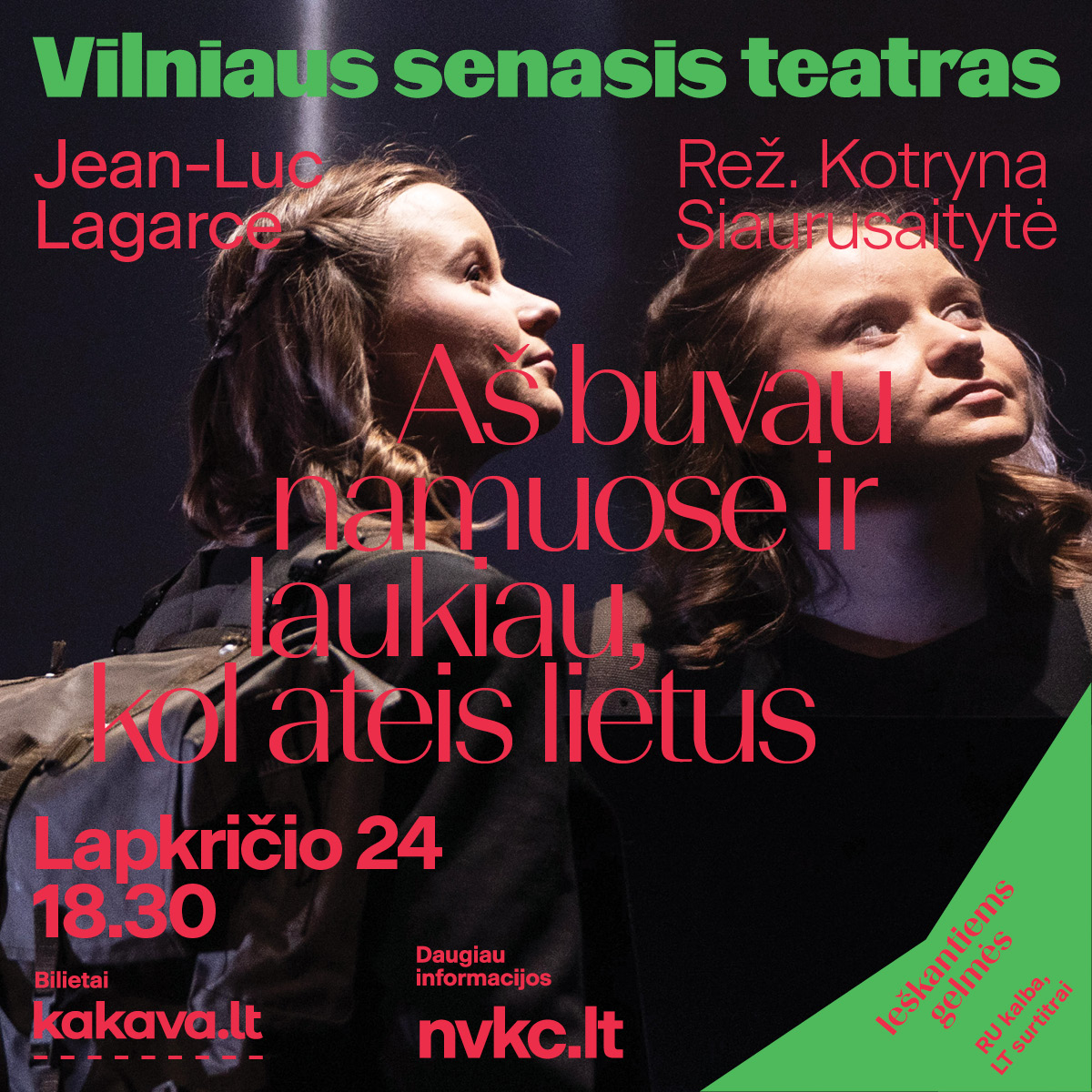
The play “I Was at Home Waiting for the Rain” by
, Jean-Luc Lagarce
November 24 at 6:30 p.m. at the Naujoji Vilnia Cultural Center
https://www.facebook.com/events/1826309451666183
Creative Team:
Director – Kotryna Siaurusaitytė
Set and Costume Designer – Arvydas Gudas
Composer – Vygintas Kisevičius
Lighting Designer – Julius Kuršys
Assistant Director – Gelena Ivaškevič
The play was translated from French by Andrejus Naumovas
Stage Adaptation – Natalia Sannikova
The play was translated into Lithuanian for the subtitles by Sigita Stanaitytė
The cast of the play includes:
The Old Woman – Valentina Lukyanenko / Vera Stasenia
Mother – Anžela Bizunovič
Chief – Anastasia Shpakovskaya
Second Place – Aleksandra Metalnikova
The youngest is Božena Aleksandrovič
Jean-Luc Lagarce’s play “I Was at Home Waiting for the Rain to Come” (“J’étais dans ma maison et j’attendais que la pluie vienne”)—the penultimate work by the French actor, director, and playwright. Written in 1994, a year before the author’s death (he died of AIDS at the age of 38), the play is one of three (alongside “It’s Only the End of the World,” 1990, “A Far Country,” 1995) that the playwright left as his final works.
“I Was at Home Waiting for the Rain to Come” tells the story of five women: three sisters, a mother, and an elderly woman. For many years, they have been waiting for their brother, son, and grandson, whom their father drove out of the house after an argument. The women’s lives seem to have come to a standstill all this time, frozen in time. He seems to have returned; he’s sleeping, lying in the bed they’ve kept for him. But is he really sleeping? Or is he dying? We don’t see him on stage, but the sense that he is there after all lingers, hanging in the air. Like a promise, the hope of a brighter future. Or is it merely a projection of the women’s hopes, fears, grievances, and expectations? In the play, the act of waiting becomes a character in its own right—like Beckett’s Godot or the shadow of the approaching planet from Lars von Trier’s *Melancholia*.
Five vivid female characters, poetic language, and metaphors captivate and enthrall—especially since the play speaks to all of our undeniable desire to exist and to find fulfillment.
After his death, J.-L. Lagarce became one of the most frequently staged contemporary French playwrights in theaters around the world. The playwright’s texts are distinguished by their complex syntax, the absence of conventional plot, a unique play structure, and the frequent use of allusions and quotations.
“I found it beautiful that the play feels as if it’s unfinished, that it has more pauses than action. This opens up space for interpretation and sparks a desire to reflect on the nature of love, self-sacrifice, and truth. The choice of this work was entirely intuitive, yet it is relevant both to me personally and to people of the 21st century. The intertwining of tragedy, depth, and gentle humor in the text has an emotional impact and explores the broad and complex theme of waiting.” (Kotryna Siaurusaitytė)
“Sometimes I feel helpless. Useless and incapable of anything, unable to act, do, or say anything. Blind and deaf, and even foolish, keeping my foolishness to myself. I wait and feel my helplessness. I freeze, feeling that I cannot open my mouth, speak, respond, or express the two or three main thoughts that have arisen in my solitude.” (Jean-Luc Lagarce. “Revue d’Esthetique,” 1994)
///
Jean-Luc Lagarce (1957–1995) was a French playwright, theater director, and actor. He studied philosophy at the University of Franche-Comté and theater arts at the Conservatory of Dramatic Arts in Besançon, and wrote 25 plays. In 1977, together with like-minded students, he founded the theater troupe “Théâtre de la Roulotte,” which J.-L. Lagarce remained a part of even after winning the Petit Odéon theater’s playwriting competition and receiving an offer to move to Paris. In Béziers, he founded the publishing house “Les Solitaires Intempestifs,” which to this day publishes texts and plays by contemporary playwrights (including his own). In accordance with the artist’s wishes, he was buried in an anonymous urn in the columbarium at the Père-Lachaise Cemetery in Paris.
Kotryna Siaurusaitytė (b. 1996) is a theater director who graduated with a degree in theater directing (under the guidance of Eimuntas Nekrošius). After graduation, she worked for several years at the Juozas Miltinis Drama Theater in Panevėžys, where she directed four productions: “Conversations on a Moonlit Night,” “The Cloak,” *The Little Prince*, and *The Extraordinary Journey of Edward Tulane*. She also assisted other directors. At the theater, he presented audiovisual installations (“Stagnation” and “Labyrinth”) with like-minded colleagues. He currently works as an assistant director at the Lithuanian National Drama Theater (LNDT).
SUPREME
I was at home, waiting for the rain to come
I looked up at the sky as I always do,
Running far, far away onto the road.
I always watch it in the evenings; I always stay up until
I sit on the threshold late at night and wait, and wait…
I waited for the rain to come and soak the ground, the paths, and the grass
and will comfort us.
MOTHER
He would always leave, and he would always come back. I couldn’t even imagine,
That he won’t come back? And that this is the beginning of all those years of waiting?
OLD
After so many years—another year of waiting,
Is that what you said?
Here, at home, it’s the same feeling of anticipation,
on the tips of one’s fingers,
wait, as if we were waiting for the baby in the upstairs room to wake up, all of us
We’ll take turns keeping watch here.
THE YOUNGEST
My time will come, I’ll step forward and make a difference
all my life.
(Jean-Luc Lagarce. “I Was at Home, Waiting for the Rain to Come.” Translated from the French by Gintaras Patackas)
The play is performed in Russian with Lithuanian subtitles.