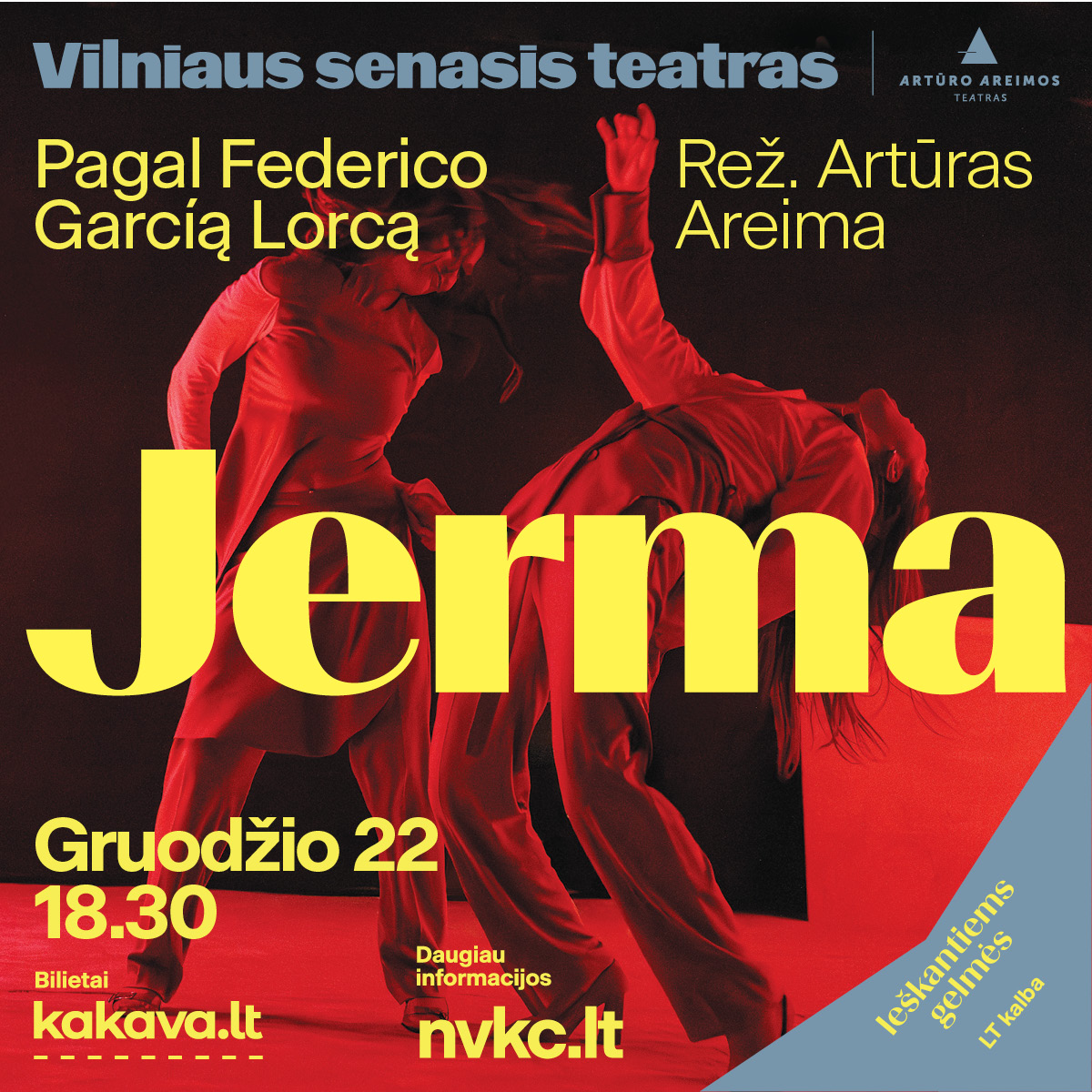
The play “Yerma” pbased on Federico García Lorca
December 22 at 6:30 p.m. at the Naujoji Vilnia Cultural Center
Tickets: https://kakava.lt/renginys/pagal-federico-garcia-lorca-jerma-rez-arturas-areima/11841/27215
Facebook event: https://www.facebook.com/events/1758302132084867
Creative Team:
Director, set designer, and adapter: Artūras Areima
Costume Designer – Valdemara Jasulaitytė
Movement Consultant – Sigita Juraškaitė
Lighting Designer – Julius Kuršys
Composer – π (Monika Poderytė)
Assistant Director – Eglė Kuzienė
The poems of Federico García Lorca were translated from Spanish by Henrikas Bakanas
The cast of the play includes:
Jerma – Eglė Špokaitė
Marija – Eglė Grigaliūnaitė
Desmina – Juliana Volodko
Elena – Liuda Gnatenko
Robert – Artur Svorobovič
Viktor – Aleksandr Kanayev / Vyacheslav Lukyanov
“Jerma” is a play about relationships that grow cold, about the body’s demands, about love that is no longer safe, about motherhood without the glamour, and about the courage to acknowledge what is often left unsaid.
Director Artūras Areima’s production, based on Federico García Lorca’s play *Yerma* (Spanish: *Yerma*), explores the theme of reproduction. The play centers on the tension between societal expectations, the pressure to have children, and an individual’s freedom to shape their own life. The play highlights different facets of motherhood and the contradictions inherent in it—the helplessness of being unable to have children and the exhaustion and fear of losing oneself after having them.
Director A. Areima adapted the play *Yerma*, written in 1934 by the Spanish poet and playwright F. G. Lorca, by transposing its vocabulary, moral dilemmas, and themes into a contemporary context.
The play tells the story of a young woman tormented by social stigma—a childless marriage. Yerma is obsessed with the idea of having a child in order to meet what she believes to be society’s expected standard. It speaks of the body, which begins to dictate more than the mind; of love that cannot be contained within the confines of a couple; of motherhood as desire, as God, as an illness, as a protest. “Yerma” speaks to the desire to find meaning when all other mechanisms that give life meaning have ceased to function.
The creative team raises issues that are particularly relevant today. How is human reproduction connected to identity, one’s role in society, and the fullness of life? What do couples who are unable to have children or who have experienced a miscarriage go through? Where does the social pressure to have a child come from?
This is a story about what happens when a woman no longer wants to be “strong,” “righteous,” or “functional,” but longs to be alive. “Jerma” is essentially not about children, but about desire.
On stage—a woman’s downfall, and yet her beauty: laughter, desire, anger, prayer. The play offers no solace or solutions; it leaves the audience face to face with questions for which there are no easy answers. It is the tragedy of the modern person who searches for meaning when God is silent, love fades, and the body still craves a miracle.
///
Federico García Lorca (1898–1936) was a Spanish poet, playwright, and prose writer. Although he is considered one of the greatest innovators of poetic and dramatic form in the 20th century, he himself never consciously sought that status. The poet always strove to stand on the side of the oppressed and the marginalized. He died under mysterious circumstances during the Spanish Civil War. He called himself a proponent of social theater; his plays highlight not only the problem of inescapable fate characteristic of Greek tragedy, but also the questionable prospects for the progress of European civilization. His plays are marked by constant anxiety, spiritual tension, the anticipation of impending danger, the fear of a violent death, and its fatal inevitability. “Yerma” is one of the parts of a trilogy (“Blood Wedding,” “Yerma,” “The House of Bernarda Alba”). In 1992, it was staged at the Kaunas National Drama Theater and the Juozas Miltinis Drama Theater.
Artūras Areima is one of the most intriguing mid-career Lithuanian theater creators. Since 2017, he has been a nominee for the “New Realities of Theater” award from the European Theater Union. He has repeatedly received the highest accolades from professional theater critics: in 2013, he was awarded the Boris Dauguvietis Earring for his exploration of new forms of theatrical expression, and on multiple occasions (in 2013, 2014, and 2015) for the Golden Stage Cross in the director category. In 2014, he founded a theater bearing his name; productions created under its banner have toured some of the most renowned theater festivals in Europe and Asia.
///
JERMA
I’m afraid of being reduced to just a body that you sometimes remember. I want a body that creates another body. I want something to grow inside me—not just thoughts and fears.
///
A co-production of the Vilnius Old Theater and the public institution “Artūras Areima’s Theater”
The project is funded by the Lithuanian Council for Culture